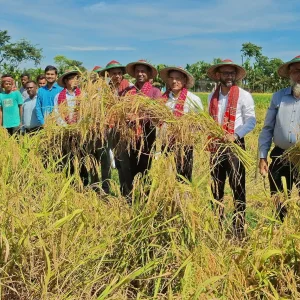
After losing money for two consecutive years on Aman and Boro rice cultivation due to waterlogging and excessive rainfall, farmer Monir Hossain of Goyalbhaor village in Matlab Uttar upazila, Chandpur, is finally seeing profit this season. He took out loans to cultivate Aman on 72 decimals of land this year. With the weather remaining favourable, the yield turned out to be good in the ongoing Kharif-2 season, and proceeds from selling paddy are restoring financial stability to his household.
Like Monir, more than 32,000 farmers in the upazila are financially benefiting from Aman cultivation this season, according to information confirmed after speaking with several local farmers during a visit to several areas of the upazila on Wednesday morning.
"After deducting production costs, I am making around 600 taka in profit per maund from selling paddy," Monir Hossain told Prothom Alo.
The farmer expects to produce around 75 maunds of paddy from his land. After deducting all production costs, he expects a net profit of about Tk 45,000 from the harvest. He believes the income from paddy sales has begun returning his household's finances to normal after two successive loss-making seasons.
Over 32,000 farmers cultivate Aman
The upazila agriculture office said Ropa Aman cultivation began in Matlab Uttar in July this year under the current Kharif-2 season. More than 32,000 farmers in the upazila planted Aman this season. Local farmers said that with harvesting now under way, money from paddy sales is bringing prosperity back to their homes.
Farmers said waterlogging and excessive rainfall caused them losses in both the Aman and Boro seasons over the past two years. This year's favourable weather and strong yields have broken that streak.
Bumper harvest in Moulvibazar, but costs weigh
Dhaka Tribune reported a bumper Aman harvest in Moulvibazar, where favourable weather has likewise boosted yields. However, the report noted that rising input costs and labour shortages are creating an risk of eroding farmers' profits there.
Farmers in both Matlab Uttar and Moulvibazar credit the favourable weather for the strong yields. The difference lies in the emphasis of the Moulvibazar report, which flags higher input costs and labour shortages as the main worry: even with higher production, those pressures could cut into overall profits, according to the concerns voiced by farmers there.
With yields strong this season, farmers believe securing fair prices would make it easier to recover from two years of losses. Harvesting and paddy sales are continuing across the districts, and the final profit tally for the season will depend on where market prices move in the coming days.