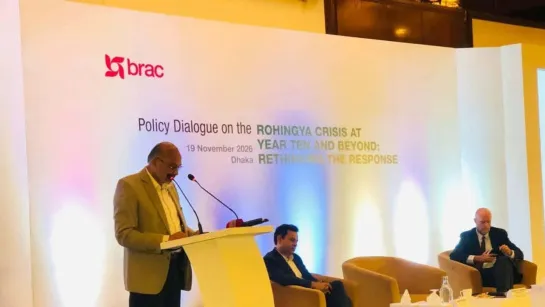
Foreign Affairs Adviser Md Touhid Hossain Titumir has called for multi-year funding to address the Rohingya crisis, warning that reduced aid will not accelerate repatriation but will deepen suffering. He cautioned that young Rohingyas are increasingly vulnerable to traffickers, drug networks and armed groups amid funding shortfalls.
19 November 2026, 3:08 PM
|
2 min read
Bangladesh has urged the international community to commit to multi-year funding for the Rohingya response, with Foreign Affairs Adviser Md Touhid Hossain Titumir warning that aid cuts will not hasten repatriation but will instead deepen the hardship of the displaced population.
Speaking at an event on Thursday (19 November), Titumir cautioned that funding shortfalls are leaving young Rohingyas increasingly exposed to traffickers, drug networks and armed groups. He stressed that the crisis requires a sustained, long-term financial commitment rather than year-to-year pledges that create uncertainty in camp management and protection efforts.
The case for multi-year funding
Titumir argued that the Rohingya crisis is a protracted situation that cannot be resolved through short-term planning. A multi-year funding framework, he said, would allow for more stable delivery of education, healthcare and security services inside the camps in Cox's Bazar, where over one million Rohingyas are currently sheltering.
Repatriation conditions
In a related development on the same day, a senior adviser to the Prime Minister called for international investment in Myanmar to help create conditions conducive for the refugees' return. The adviser noted that sustainable repatriation depends on ensuring safety and dignity for returnees inside Myanmar, which requires economic and political engagement with the country.
ICJ proceedings
Bangladesh has also expressed hope that the ongoing International Court of Justice (ICJ) case against Myanmar will advance the cause of justice and accountability for the Rohingya community. Officials believe a favourable ruling could strengthen the legal and diplomatic framework needed to push for safe and voluntary repatriation.
Risks and challenges
Humanitarian agencies have already reduced food rations in the camps due to funding constraints, raising concerns about malnutrition and social instability. Titumir's remarks underscore a broader consensus among Bangladeshi officials that cutting aid will not resolve the crisis but will instead exacerbate vulnerabilities and threaten regional security.