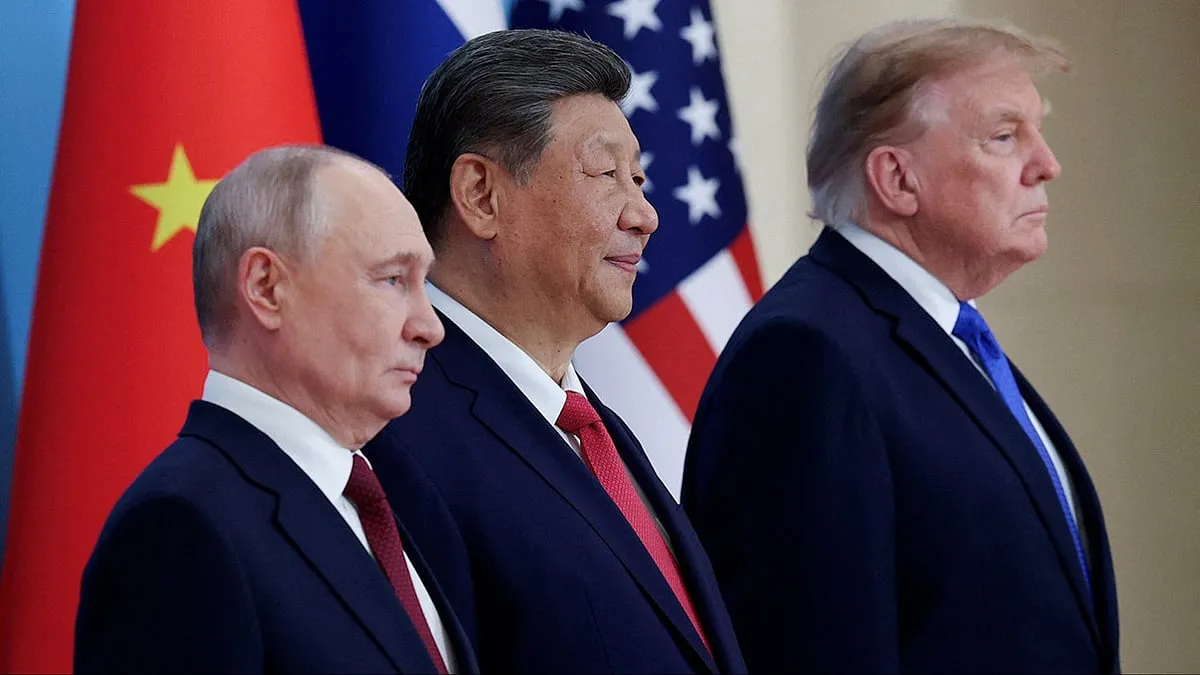
US President Donald Trump, Chinese President Xi Jinping and Russian President Vladimir Putin have pledged not to wage nuclear war against one another at what has been described as an unprecedented trilateral meeting, according to a Prothom Alo video report published on the night of 19 November 2026. At the same meeting, the three leaders reached consensus on plans to expand fuel oil production and supply as well as on reforming the United Nations.
The commitment marks the first known occasion on which the heads of the world's three largest nuclear powers have met in a trilateral format and pledged to avoid nuclear conflict. The United States and Russia together hold roughly 90 per cent of the world's nuclear warheads, while China possesses the fastest-growing third-largest arsenal. Relations among the three capitals have been repeatedly strained in recent years by the war in Ukraine, tariff and technology disputes and intensifying strategic competition, lending the joint pledge added weight in global diplomacy.
An unprecedented diplomatic format
Bilateral summits among Washington, Beijing and Moscow are routine, but a gathering of all three heads of state has no precedent, which is why the Prothom Alo report termed the meeting unprecedented. All three countries are permanent members of the UN Security Council and recognised nuclear-weapon states. Whether the political signal matures into an institutional framework is now the central question for observers.
The nuclear pledge
The Prothom Alo report stated:
"At the unprecedented meeting, the presidents of the United States, China and Russia pledged not to wage nuclear war. They also agreed on fuel supply and United Nations reform."
The pledge follows the lapse of New START, the last bilateral arms control treaty between Washington and Moscow, which was due to expire in February 2026. With the strategic arms control architecture weakened, a direct no-nuclear-war commitment from all three recognised nuclear powers is viewed as significant for reducing nuclear risk. The report did not clarify whether the pledge takes any legally binding form.
Oil production and supply
Central to the meeting was a plan to increase fuel oil production and supply. The United States and Russia rank among the world's leading producers of crude oil and natural gas, while China is the largest energy importer.
Coordination on output and supply among the three could influence global fuel prices and energy security. For economies heavily dependent on fuel imports, an initiative toward stability in a volatile global energy market carries clear significance.
The report, however, provided no details on the plan's scope, production targets or implementation timelines.
Consensus on UN reform
Beyond energy, the three leaders also agreed on reforming the United Nations. As three of the five permanent, veto-wielding members of the Security Council, their aligned position is notable given longstanding calls to address the council's paralysis and the use of the veto. The nature of the consensus and any specific reform agenda were not detailed in the initial report.
Details awaited
The venue and duration of the meeting, and whether a joint statement or memorandum was signed, were not mentioned in the Prothom Alo video report. Official statements from the three governments' spokespeople were also not quoted.
International attention now turns to follow-up announcements on implementation, further meetings and any legal framework underpinning the pledges. Whether the consensus across nuclear security, energy markets and UN reform proves effective will depend on sustained political follow-through in the coming days.